Bull Terrier
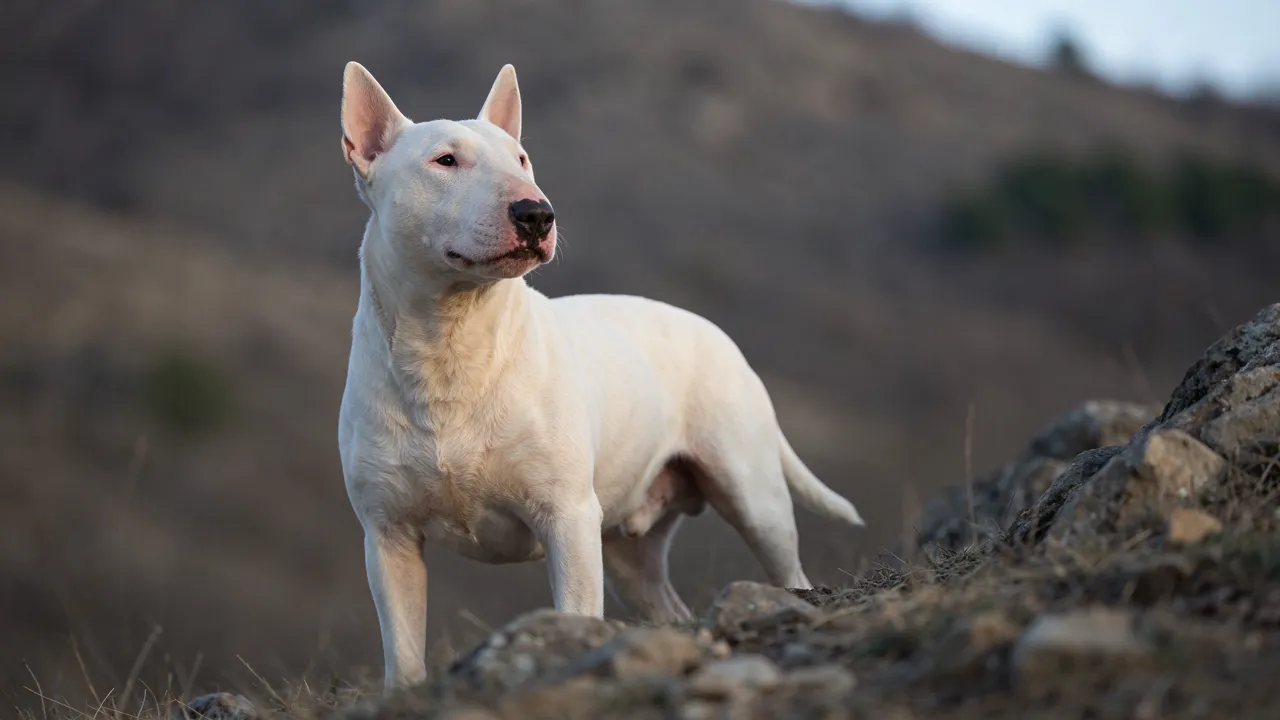
The Bull Terrier emerged in 19th-century Britain from the bull-and-terrier type: crosses developed for blood sports by combining the strength of bulldog-type dogs with the speed and tenacity of terriers. After bull-baiting was outlawed in 1835, dog fighting and ratting continued to shape these dogs’ reputation and selection. The historical dogs were not identical to today’s breed; they varied in size, appearance, and ancestry.
Breeder James Hinks of Birmingham helped establish the modern Bull Terrier in the 1850s and 1860s, selecting a more uniform, predominantly white dog with a cleaner outline and a distinctive head. Accounts of the precise crosses differ, but the English White Terrier—now extinct—and Dalmatian are commonly cited among the influences, alongside bull-and-terrier stock. Hinks’s breeding shifted emphasis from fighting utility toward a recognizable show and companion dog, although the breed retained the muscularity, persistence, and high activity associated with its ancestry.
The Kennel Club recognized this breed in 1885, and the Bull Terrier Club was formed in 1887. Early preference for white dogs created practical and welfare concerns: congenital deafness occurs more often in predominantly white dogs, particularly when pigmentation is absent around the inner ear. Colored Bull Terriers were subsequently developed through breeding that reintroduced color, including crosses with Staffordshire Bull Terriers; the Kennel Club recognized colored dogs as a separate variety in 1939. Miniature Bull Terriers were also bred down in size and later established as a distinct breed, rather than simply being small individuals from standard-sized lines.
The Bull Terrier has a strongly muscled, compact body built for forceful movement rather than endurance at speed. Breed standards set no fixed height or weight for the standard variety; adults commonly stand about 21–22 inches (53–56 cm) at the shoulder and weigh roughly 50–70 pounds (23–32 kg), but soundness and proportion matter more than a particular figure. The Miniature Bull Terrier is a separate breed, limited to 14 inches (35.5 cm) at the shoulder.

Amazon Basics Leak-Proof Dog and Puppy Potty Training Pee Pads with Quick-Dry 5-Layer Super Absorbent Design, Regular Size 22 x 22 inch, Blue & White, 100 Count
(as of November 28, 2026 01:09 GMT +00:00 - More infoProduct prices and availability are accurate as of the date/time indicated and are subject to change. Any price and availability information displayed on [relevant Amazon Site(s), as applicable] at the time of purchase will apply to the purchase of this product.)Its defining feature is a long, oval head with a gently arched profile from the skull to the tip of the nose, without a pronounced stop between forehead and muzzle. The small, dark, triangular eyes sit close together and give the face its characteristic narrow expression; the ears are small, thin, and carried erect. Strong jaws meet in a scissors bite. A markedly curved profile or unusually narrow head should not compromise breathing, vision, or normal jaw function.
The broad, deep chest, rounded rib cage, short, strong back, and well-muscled limbs give the dog a solid outline without making it heavy or cumbersome. The tail is set low, thick at the base, and tapers toward the tip; it’s usually carried horizontally or slightly raised during movement. A sound Bull Terrier moves freely and smoothly, with coordinated reach and drive. Excess body fat can obscure the breed’s natural outline and add avoidable load to the joints, so body condition is best assessed by feeling for ribs beneath a light fat covering and checking for a visible waist from above.
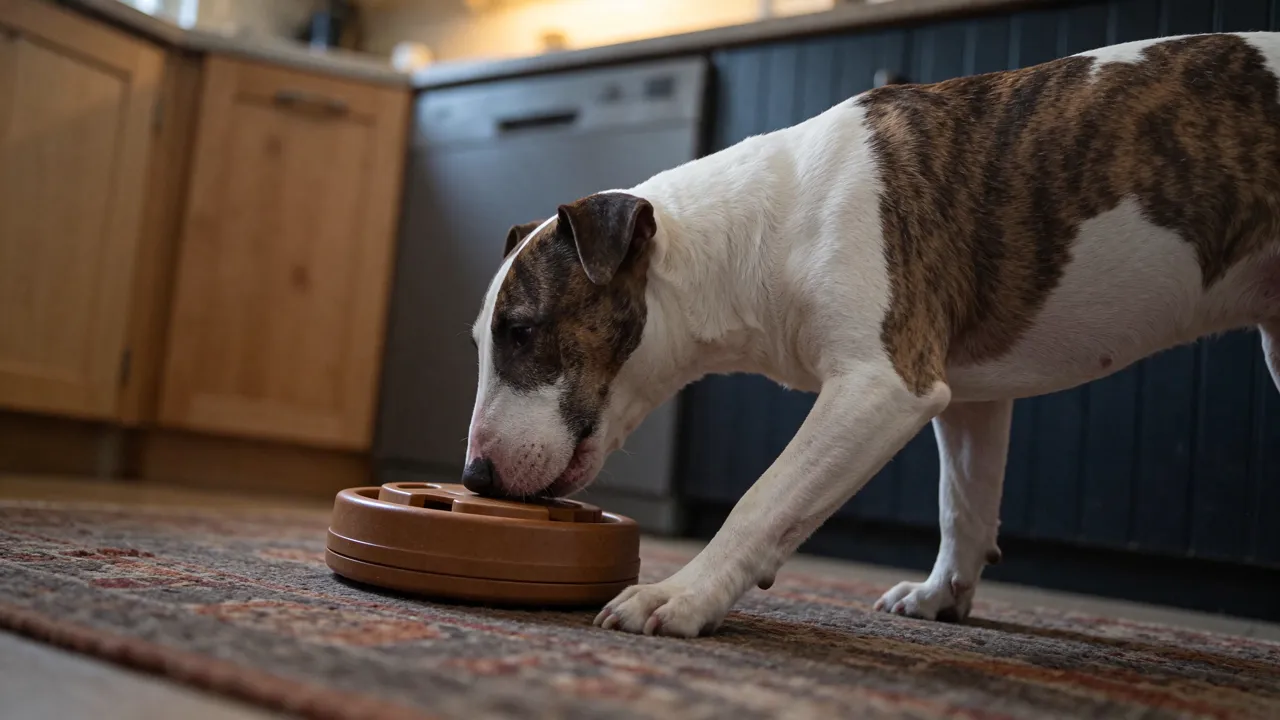
The coat is short, flat, and firm, with a slight sheen; it offers little protection from cold or wet weather. Accepted colors include white and colored varieties, commonly brindle, fawn, red, or black brindle, often with white markings. Predominantly white skin can be more vulnerable to sunburn, especially on sparsely haired areas such as the nose and ears; limit intense midday sun and use dog-safe sun protection when advised by a veterinarian. The short coat makes skin changes easy to notice, so persistent redness, itching, sores, or hair loss warrant assessment rather than being attributed to normal shedding.
Bull Terriers are energetic, persistent dogs that often approach play with considerable force. Their terrier heritage can produce strong interest in moving animals and objects, while their muscular build means that exuberant jumping or body-checking can overwhelm young children or frail adults. Supervise interactions, teach calm greetings, and provide children with protected spaces where the dog cannot follow.
They learn readily when training is brief, consistent, and rewarded with food, toys, or access to play. Their determination can become conflict if handled with intimidation or repeated physical restraint; reward-based practice and clear household rules are more likely to build reliable cooperation. Train a dependable recall and loose-leash walking early, and use secure fencing because pursuit may override a response to familiar cues. Some Bull Terriers are selective with unfamiliar dogs or intolerant of rough interactions, so introduce dogs gradually and do not assume that social exposure will make every individual enjoy canine company.
Daily activity should combine brisk walks, sniffing, problem-solving games, and short training sessions. A yard alone does not meet these needs. Provide durable, appropriately sized chew items and rotate food puzzles to channel chewing and exploration; supervise toys that can be swallowed or broken into sharp pieces. Repeated pacing, destructive chewing, or persistent attention-seeking can indicate insufficient activity, frustration, or difficulty coping alone. Build periods of solitude gradually rather than leaving a newly acquired dog for a full workday without preparation.
Feed a complete, life-stage-appropriate diet and measure portions; the breed’s solid frame can hide excess fat, which increases joint loading. Keep growing puppies lean and avoid forced repetitive jumping or long runs while their skeletons mature. Check body condition regularly by feeling the ribs and looking for a waist, and adjust calories with veterinary guidance rather than relying only on package feeding amounts.
Health screening should include hearing assessment: congenital deafness is more frequent in predominantly white dogs and can affect one or both ears, so BAER testing is more reliable than judging response to sound at home. Ask breeders about inherited kidney disease, heart abnormalities, patellar luxation, and primary lens luxation, and discuss appropriate examinations and genetic tests with a veterinarian. Increased thirst or urination, poor growth, weakness, cloudy eyes, sudden vision changes, or recurrent skin inflammation merit prompt evaluation. Routine care includes nail trimming, dental cleaning, ear checks, and protection from cold, rain, and intense sun because the short coat provides limited insulation.
Related Posts

“Earth Rated Dog Poop Bags on Refill Rolls, 600 Bags, Lavender”

“BoYoYo Interactive Dog Toys”

Canine Vision Problems – Signs and Solutions
Essentials
 Dog Shaver Clippers
 earthbath Hypo-Allergenic Grooming Wipes
 HONEY CARE All-Absorb Male Dog Wrap
 Comotech 3PCS Dog Bath Brush | Dog Shampoo brush | Dog Scrubber for Bath | Dog/Grooming/Washing Brush Scrubber with Adjustable Ring Handle for Short & Long Haired Dogs/Cats (Blue Blue White)
 LACRTOPE Pet Bowl Cleaner Tablets