Beagle
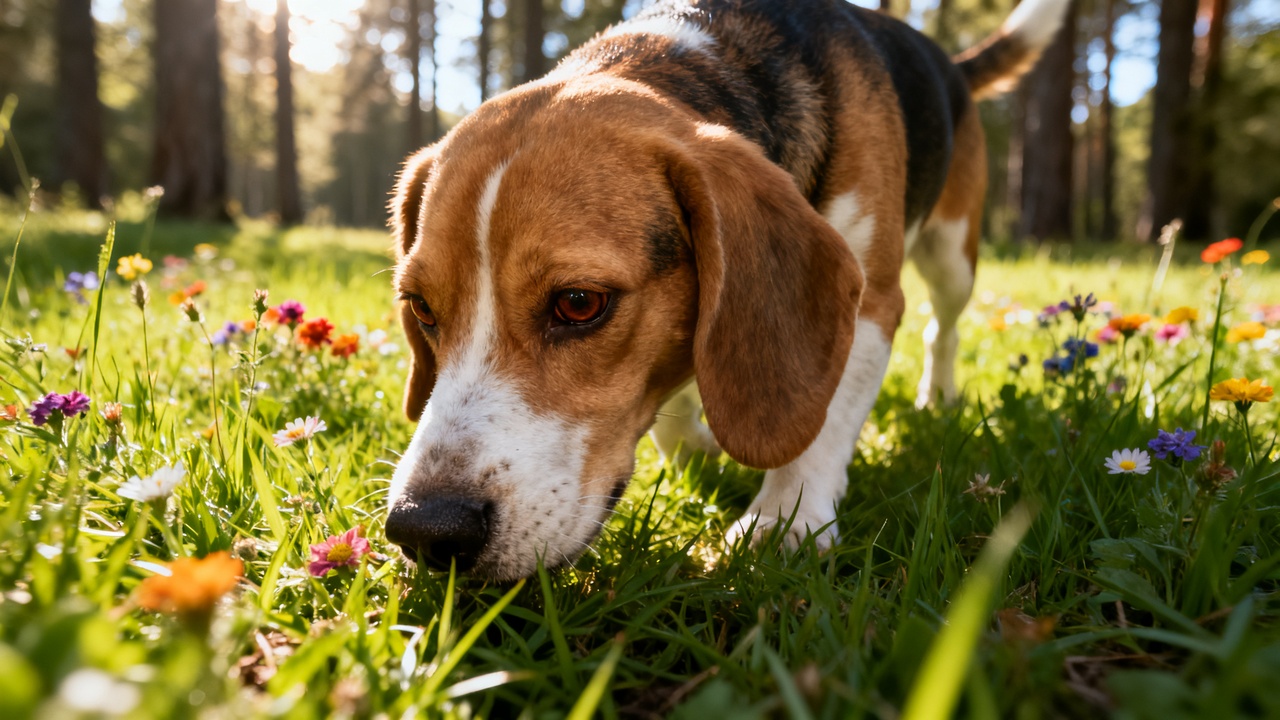
The beagle-type hound developed in England as a compact scenting dog selected for persistent ground-level tracking rather than speed or size. Its ancestry is shared with small foxhounds and older hare-hunting hounds, with deliberate breeding favoring a strong olfactory system, a voice that can carry to hunters on foot, and enough endurance to work for long periods over mixed terrain. The breed’s original function shaped nearly every inherited trait: a low center of gravity for stability in brush, a short coat that resists snagging, and an intense motivation to follow odor trails even when visual cues are absent.
Selective breeding in the 18th and 19th centuries produced several regional beagle strains, including smaller “pocket” hunting dogs used for rabbit work. These lines were not bred for uniform appearance first; they were bred for hunt utility, which explains why modern beagles often show more variation in size and head type than breeds standardized primarily for the show ring. When formal breed standards were later imposed, the emphasis shifted toward a consistent outline while preserving the functional nose, voice, and pack-oriented hunting style that define the breed’s behavior today.
The breed’s scenting ability is not merely “good smell”; it reflects dense olfactory receptor architecture, a large nasal surface area, and behavioral persistence under distraction. Dogs selected for tracking had to ignore competing stimuli and continue working independently of direct human guidance. That historical pressure is still visible in modern individuals that become intensely absorbed in odor trails, show delayed response to recall when aroused by scent, and use vocalization as part of their communication pattern.
Beagles were historically expected to work in groups, so pack selection favored low aggression toward conspecifics and tolerance of close social contact. This does not guarantee easy socialization, but it does help explain why many beagles display less guarding of resources and more interest in social and olfactory exploration than breeds selected for territorial defense. The same heritage can also make them prone to opportunistic food seeking, because hunting dogs were often rewarded intermittently and learned to exploit access to calorie-dense scraps.

Blue Buffalo Bits Beef Training Treats, 19 oz | Real Beef First, DHA for Cognitive Development, No Chicken By-Product Meals, Free from Red Dye 40
$14.98 (as of September 24, 2026 05:05 GMT +00:00 - More infoProduct prices and availability are accurate as of the date/time indicated and are subject to change. Any price and availability information displayed on [relevant Amazon Site(s), as applicable] at the time of purchase will apply to the purchase of this product.)Modern companion beagles retain the consequences of this working background. They are still genetically organized to search, persist, and self-reward through scent discovery, which means owners see a breed that was engineered to make its own decisions in the field. In practical terms, the historical beagle is not a miniature “generic pet hound”; it’s a purpose-bred odor specialist whose behavior, endurance, and vocal expression are direct products of centuries of selection for rabbit and hare work.
From a physical standpoint, the breed is compact, muscular, and built for efficient ground coverage rather than top-end speed. The body is slightly longer than tall, with a level back, deep chest, and well-sprung ribs that support sustained aerobic work without the heavy frame that would slow quartering in dense cover. Strong, moderately angled hindquarters provide propulsion, while the forelimbs are set to absorb repeated turns and sudden stops during scent tracking. That combination creates a dog that can move with surprising stamina over long distances, even though individual strides remain relatively short.
The head is shaped to support olfactory work. A broad skull, pronounced but not exaggerated stop, and a full muzzle provide room for nasal structures and jaw musculature. Loose skin around the face and slightly pendulous ears help funnel scent toward the nose by disturbing airflow near the muzzle and retaining odor particles close to the nostrils. The ears are not ornamental; they are part of the working package, and their length and set are functionally related to scent capture, although they also create a predisposition to moisture retention and otitis if ventilation is poor.
Expressive eyes are typically brown or hazel, set well apart, with an alert but not sharp expression. This does not indicate passivity; it reflects a breed selected for cooperative field work rather than conflict. The eye rims should be tight enough to limit irritation, but excessive looseness can increase conjunctival exposure and tear staining. A healthy beagle should appear attentive, with a head carriage that suggests forward interest in environmental cues rather than constant vigilance for people-directed commands.
The coat is short, dense, and weather-resistant, designed to shed light debris and protect against moderate brush. It is low-maintenance in the sense that it does not mat easily, but it isn’t self-cleaning enough to ignore skin health. Because the coat lies close to the body, changes in condition are easy to detect: dullness, scaling, or localized thinning can signal poor nutrition, ectoparasites, endocrine disease, or chronic over-bathing. Color patterns vary widely, most commonly tricolor, lemon and white, red and white, or tan-based combinations, and the variation has little bearing on function.
Size should be evaluated as a working balance rather than a cosmetic endpoint. Individuals at the lower end of the range may be more agile in tight cover but can be more vulnerable to cold exposure and caloric deficit during high activity. Heavier individuals may have the same scenting drive but carry greater orthopedic load, especially across the stifle, elbow, and lumbosacral regions. Because the breed is food-motivated and readily overconditioned, visible rib definition and a clear waist are practical indicators, not aesthetic preferences, of a body capable of efficient movement and lower joint stress.

Structural faults matter because they alter how the dog moves and ages. Excessively straight shoulders reduce reach, weak pasterns increase impact stress, and overly long backs can compromise spinal support during abrupt turns. Overly narrow chests may reduce respiratory reserve, while very heavy frames increase fatigue and heat burden. In a scent hound, form should support repetitive search behavior without forcing compensatory movement patterns that accelerate wear on joints and soft tissues.
Observable signs of a well-balanced individual include:
- steady, economical gait with minimal wasted motion
- clean foot placement and good traction on varied surfaces
- narrow but not pinched waist with palpable muscle over the thighs
- ears that are clean, dry, and free of odor
- coat that feels resilient rather than greasy or brittle
- eye expression this is bright without redness or discharge
Because this breed was shaped for endurance and scent discrimination, subtle physical changes often show up before major illness. A drop in willingness to move, shortened stride, head-shaking, or altered nose use can reflect pain, ear disease, obesity, or nasal irritation. Owners who understand the breed’s structure can detect these changes early by watching how the dog uses the body rather than relying on static appearance alone.
Behaviorally, this breed is a high-reward, low-inhibition scent hound: it will repeat whatever successfully produces odor access, movement, or food. That learning profile makes it extraordinarily trainable when the environment is arranged correctly and notoriously unreliable when it isn’t. Because olfactory input is neurologically dominant, a beagle may appear to “ignore” cues when in fact the cue has been outcompeted by a stronger sensory reinforcer. For this reason, recall must be built with progressive distraction control, not tested casually in open areas where scent can override reinforcement history.
Food motivation is intense because the breed was historically selected to work hard and then recover energy quickly. This predisposes many individuals to rapid operant learning around food containers, counters, dropped crumbs, and garbage access. It also means that calorie intake must be managed with the same precision used for working dogs, even in pets that are not hunting. Chronic overfeeding produces a predictable sequence: increased body fat, reduced enthusiasm for exercise, altered gait mechanics, then greater risk of cruciate overload, hepatic lipidosis during fasting events, and heat intolerance. Body condition scoring is more reliable than scale weight because bone structure and gender influence absolute mass.
Training should exploit the breed’s reinforcement sensitivity rather than fight its scenting system. Short, repeated sessions with immediate reward produce better learning than long repetitions that lead to odor-seeking drift. Remote rewards, treat trails, nosework, and controlled searching channels the dog’s hereditary foraging pattern into behavior that can be reinforced. Punishment is especially ineffective when the dog is already in a high-arousal scent state; it may suppress visible behavior briefly without changing the underlying motivation and can reduce responsiveness when the dog most needs management.
Vocalization is part of the breed’s functional repertoire, not a random nuisance behavior. Baying, whining, and alert barking often increase when arousal, frustration, or scent pursuit is high. The practical task is not to eliminate expression but to prevent reinforcement of uncontrolled vocal output. Dogs that are repeatedly released, fed, or allowed to move forward while vocalizing can learn that noise opens access to goals. Quiet behavior should be reinforced in low-arousal contexts before adding scent, movement, or separation triggers.
Separation-related distress can occur because the breed is socially oriented and highly pattern-sensitive. It is not typically a clingy breed in the toy-dog sense, but many individuals struggle when social access, food access, or environmental novelty suddenly disappear. Signs include persistent vocalization, door-focused pacing, destructive searching, and increased salivation. These behaviors are intensified by inadequate exercise, irregular routines, and long periods without olfactory work. Structured departures, chew-based enrichment, and predictable feeding schedules reduce the probability of frustration-based behavior, but they do not replace gradual alone-time conditioning when distress is already established.
Management must also account for the dog’s nose as a welfare issue. Off-leash freedom in unfenced areas can be unsafe because a scent-directed dog may travel beyond visual supervision with little acknowledgment of distance or terrain change. Secure fencing, double-door exits, and leash discipline are not optional conveniences; they are risk controls for an animal whose primary reinforcement comes from following invisible trails. In multi-dog homes, the breed usually tolerates social proximity well, but resource competition can emerge around food, toys, or resting places if access is inconsistent or if humans inadvertently reward pushy behavior at mealtimes.
For a beagle, the most effective care plan is one that respects olfactory urgency: earnable food, controllable search outlets, low-friction routine, and environmental security. Meeting those needs prevents many of the problems commonly mislabeled as stubbornness.
Related Posts
Canine Asthma – Symptoms and Treatment Options
Raw Bones for Dogs: Nutritional Benefits and Safety Tips